Aqueduct 4.0 в Living Atlas provides one of the most comprehensive datasets on water risk in the world through the ArcGIS Online platform
Water scarcity is one of the key challenges of the coming decades. The growing population will place additional pressure on available water resources. Already, 10% of the world’s population is experiencing high water stress. In addition, water use has been increasing at a rate twice as high as the rate of population growth. This deepens the crisis, but at the same time shows that with decisive action, significant positive results can be achieved. By 2050, ensuring food security, reducing water stress, and preventing water scarcity will be critical priorities.
Integrated water resources management is a process for coordinating the development, management, and use of water across human activities and ecosystems. The process of integrated management requires informed decisions supported by comprehensive data—data that integrate and transform the outputs of complex hydrological models into indicators of water resource conditions. These indicators assess and define factors such as water stress, water depletion, and associated risks, including risks from floods, droughts, coastal impacts, and regulatory challenges. Tools that translate complex hydrological data into decision-relevant indicators, such as Aqueduct, are essential.
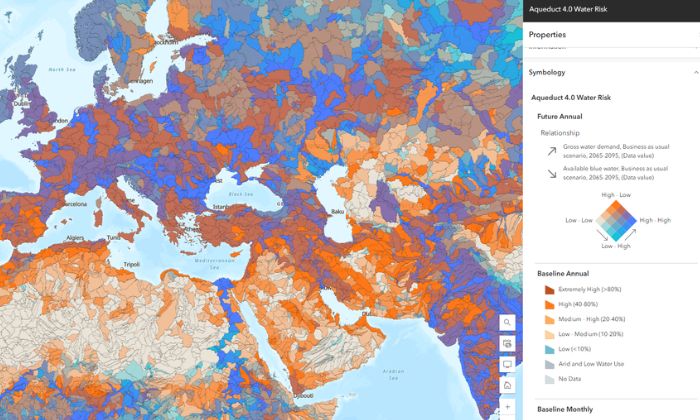
The Aqueduct 4.0 Global Water Risk dataset, developed by the World Resources Institute (WRI), is now freely available in the ArcGIS Living Atlas of the World. Aqueduct 4.0 transforms the outputs of the complex hydrological model PCR-GLOBWB 2 into intuitive water risk indicators. This comprehensive framework assesses both current conditions and future projections of water resources to support decision-making. The data are also available for Bulgaria.
Baseline conditions and future projections
Aqueduct 4.0 provides water risk assessments for a baseline period (1979–2019) and for three future projection periods:
2015–2045
2035–2065
2065–2095
as well as under three climate and socio-economic development scenarios:
Optimistic scenario (SSP1-RCP2.6)
“Business-as-usual” scenario (SSP3-RCP7.0)
Pessimistic scenario (SSP5-RCP8.5)
The projections use climate impacts from CMIP6 and the PCR-GLOBWB 2 hydrological model. In addition, Aqueduct includes sector-specific weighting schemes for assessing water risks across different industries.
Understanding water risk
Aqueduct provides a comprehensive framework that evaluates 13 distinct water risk indicators, grouped into three main categories:
Physical risks – quantity
These indicators assess the availability and variability of water resources, including: water stress, water depletion, interannual variability, groundwater table decline, river flood risk, coastal flood risk, and drought risk.
Physical risks – quality
Indicators related to water quality that affect its usability: untreated connected wastewater and coastal eutrophication potential.
Regulatory and reputational risks
Indicators related to governance and access: population without access to improved drinking water and population without access to improved sanitation.
Aqueduct in Living Atlas
Aqueduct in Living Atlas includes three layers:
Future Annual, which provides water risk indicators for three future time periods under multiple climate scenarios;
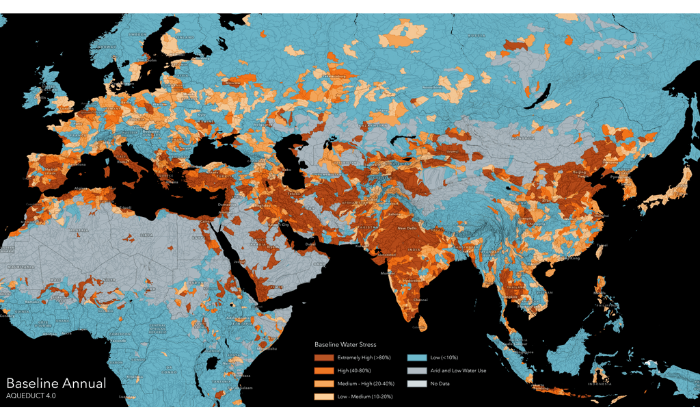
Baseline Annual, which provides indicators for the historical baseline period (1979–2019) in order to establish reference values for comparison;
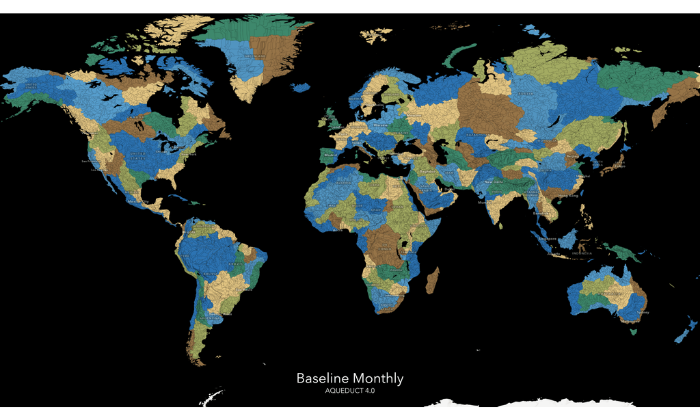
Baseline Monthly, which provides monthly data on water stress and water depletion, particularly useful for regions with clearly defined wet and dry seasons.
Cartography
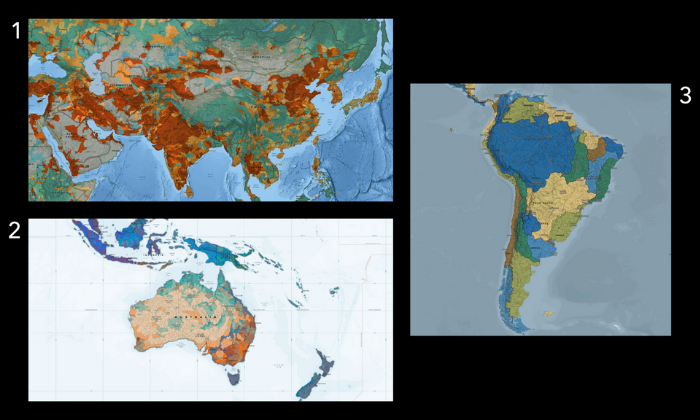
These layers are designed to work with a wide range of Esri basemaps. The colors use high saturation values in order to provide greater flexibility when applying custom cartographic styles. They are also designed for use with Layer Effects, Blend Modes, and transparency to further enhance visualization.
Symbology and pop-ups
Each layer includes customizable symbology and pop-ups tailored to its specific focus.
Future (Annual)
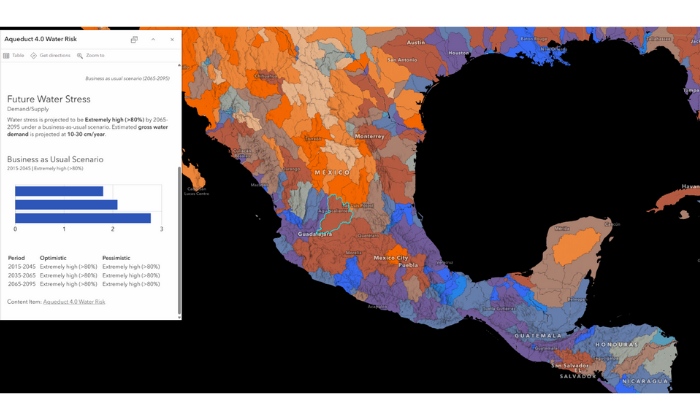
The symbology displays a bivariate map of gross water demand and water availability for the “business-as-usual” scenario (2065–2095). This visualization highlights contrasts between areas with high demand and low availability, high demand and high availability, low demand and high availability, and low demand and low availability. The pop-up displays projected demand and availability, as well as water stress projections for all three periods and scenarios.
Baseline (Annual)
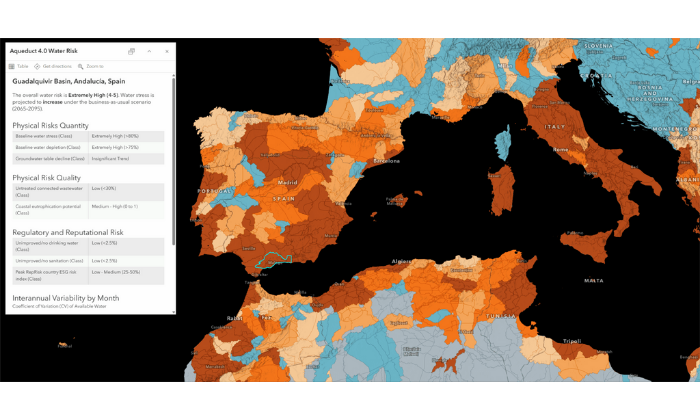
The annual baseline layer uses water stress as the basis for the symbology and highlights basins with extremely high or high overall water risk. The pop-up summarizes water risks by category and shows interannual variability by month to indicate whether conditions vary significantly throughout the year or remain relatively stable.
Baseline (Monthly)
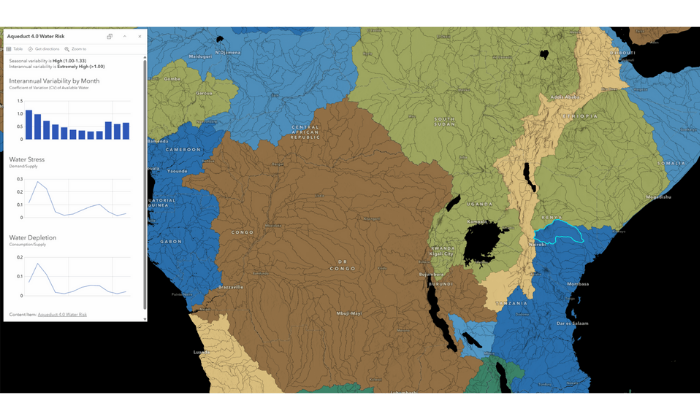
The pop-up displays seasonal and interannual variability, as well as monthly charts of water stress and water depletion. Instead of showing results for a specific month, the layer visualizes major basins identified by the first three digits of the Pfafstetter code.
Filtering and customization
Similar to other layers in Living Atlas, Aqueduct layers can be added to custom maps, used in analyses in ArcGIS Online or ArcGIS Pro, and filtered to focus on specific categories or risk indicators. For example, layer views can be created to show basins with extremely high baseline water stress (score above 4.0), areas with groundwater level decline, or areas facing both physical and regulatory water risks.
Summary
Aqueduct 4.0 is now available in Living Atlas and provides one of the most comprehensive datasets on water risk in the world through the ArcGIS Online platform. As part of the Living Atlas collection, Aqueduct joins authoritative datasets on environment, climate, and demography to support better decision-making and strengthen integrated water resources management processes. Aqueduct supports the development of actionable strategies to reduce water scarcity in the coming years.
###